Table of Contents
Usage of superconductors date from a few decades back and are used in some of the complex machines like bullet trains, MRI machines etc..
They are indeed some of the fascinating materials made by humanity.
Unlike others, these behave as “perfect” materials for tasks like transportation of electrical energy with absolute zero loss, and possess some unique properties which are discussed below.
Superconductivity and Resistance
When an electric current (I) is passed through a conductor wire for a certain time (T), some of the electrical energy due to the current always gets lost as heat energy. This energy loss is due to the electrical resistance (R) of the conductor and can be measured as E = I²RT.
However, in 1911, Dutch physicist Heike Kamerlingh Onnes was studying the resistance of mercury with varying temperature. He made the remarkable discovery that the resistance of mercury abruptly falls to zero at a specific temperature, later measured to be about 4.2 K.
This discovery gave rise to the physics of superconductivity.
This temperature is called the critical temperature (Tc) of the material. When a conductor is cooled below its critical temperature, it behaves as a superconductor, exhibiting zero electrical resistance and zero energy loss.
The Meissner Effect
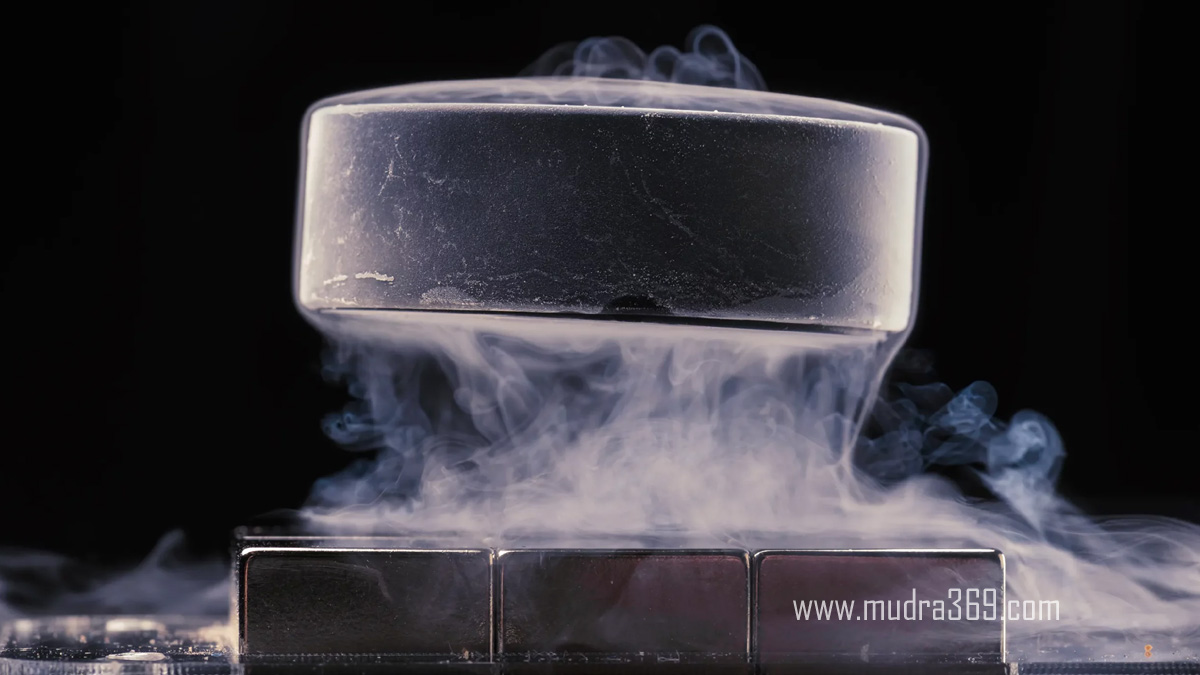
These superconducting materials, apart from zero energy loss, show even more interesting behavior. One of these phenomena is known as the Meissner effect. This effect states that when a conductor is cooled below its critical temperature (Tc) and transitions into the superconducting state, it expels all magnetic flux from its interior.
The Meissner effect is a key characteristic of a superconductor and provides the foundation for magnetic levitation.
The phenomenon is often explained by the fact that when a superconductor is placed in a magnetic field, it develops supercurrents on its surface. These supercurrents produce their own magnetic field, which is exactly equal and opposite to the external magnetic field. The net result is the complete cancellation of the magnetic field inside the material, which causes the strange effect where a magnet appears to float above the superconductor.
Applications
This unique quality of superconductors enables their use in many significant applications, including magnetic levitation, high efficiency electric motors, advanced computing, medical imaging such as MRI, and lossless power cables etc.