
Table of Contents
Have you ever wondered why the latest breakthroughs in artificial intelligence might ultimately depend on plumbing rather than code? As AI models become exponentially more powerful, the physical infrastructure supporting them is facing a critical thermal limit.
At the heart of the AI revolution are high-power GPU clusters, and these chips run incredibly hot. Traditional air-cooling systems—essentially giant fans blowing chilled air across server racks—are rapidly becoming insufficient.
To prevent these supercomputers from literally melting down, the industry is pivoting toward high-density liquid cooling (HDLC).
The Shift from Air to Liquid
Liquid cooling is not a new concept—gamers have used it for years to overclock personal PCs—but scaling it to the enterprise level represents a massive engineering challenge.
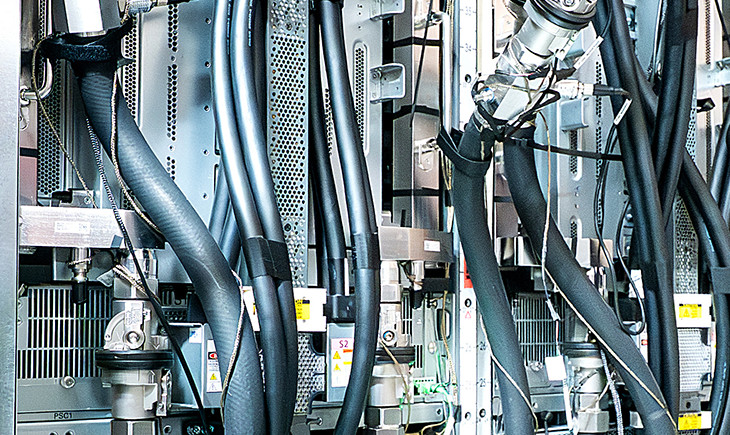
In a direct-to-chip liquid cooling setup, cold plates are affixed directly onto the hottest components, such as the CPU and GPU.
A cooling fluid, often a specialized dielectric liquid or treated water, circulates through micro-channels within these plates.
Because liquids have a significantly higher heat capacity than air, they can absorb and carry away massive amounts of thermal energy far more efficiently.
The Core Engineering Mechanics
From a thermodynamics perspective, the efficiency of liquid cooling comes down to the principles of heat transfer.
The rate of heat conduction is dictated by Fourier’s law, where the thermal conductivity of the fluid plays a major role. Water, for instance, has a thermal conductivity over 20 times higher than that of air.
Furthermore, the specific heat capacity of water is roughly four times that of air, meaning it can absorb four times as much heat per unit mass for the same temperature rise.
When designing these systems, engineers must meticulously manage fluid dynamics, balancing the flow rate against the pressure drop across the micro-channels to optimize the heat transfer coefficient without demanding excessive pumping power.
The Modern Application
This technology is now actively being deployed. Just this week, major infrastructure providers like Vertiv announced significant expansions in direct-to-chip liquid cooling deployments.
In markets like India, the first fully liquid-cooled AI data centers are now coming online, marking a pivotal shift in how digital infrastructure is built.
These facilities not only allow for denser server packing—maximizing compute power per square foot—but they also drastically reduce the energy consumption previously wasted on giant HVAC fans.
As AI models continue to scale, the hum of server fans will likely be replaced by the quiet rush of coolant.
Liquid cooling is no longer a luxury; it is a fundamental requirement for the next generation of artificial intelligence.
